This post was archived from createpositivechange.org/. View the original on the Wayback Machine.
Category: Business
-
GM discussing merger with Chrysler, Times reports
This post was archived from createpositivechange.org/. View the original on the Wayback Machine.
-
Citigroup buys Wachovia’s banking assets
FDIC Chair Sheila C. Bair has overseen another shot-gun wedding – this time between Wachovia Corporation and Citigroup.
Citigroup agreed to pay $1 a share, or about $2.2 billion for Wachovia’s banking operations, according to media reports, in the latest deal brokered by federal officials as a result of the distressed mortgage market.
Hint: Click in map to explore connectionsStory continues below interactive map

 Click to activate the interactive map (requires Java)MAP HINTS: Click expands a name. Control+Click centers map on a name. Solid lines are current relations. Dotted lines are former relations. For advanced tools choose Tools > Options from the menu at top. More help. Not seeing the maps? Please go here to check for the latest version of Java.
Bair’s FDIC was a major player, agreeing to absorb losses from Wachovia above $42 billion and receive $12 billion in preferred stock and warrants from Citigroup – making U.S. taxpayers a stakeholder.
She stressed that the storied Charlotte bank did not fail, like Washington Mutual, which was seized by the authorities after suffering a run on deposits last week.
“This morning’s decision was made under extraordinary circumstances with significant consultation among the regulators and Treasury,” Bair said in a statement. “This action was necessary to maintain confidence in the banking industry given current financial market conditions.
“There will be no interruption in services and bank customers should expect business as usual,” she said.
Wachovia will remain a public company, retaining its asset management and retail brokerage businesses, including the Evergreen franchise and the A.G. Edwards brokerage division.
The New York Times points out that the deal further concentrates Americans’ bank deposits in the hands of just three banks: Bank of America, JPMorgan Chase and Citigroup. Together, those three would be so large that they would dominate the industry, with unrivaled power to set prices for their loans and services.
Wachovia had been hurt badly by its 2006 purchase of Golden West Financial, a California lender specializing in so-called pay-option mortgages. The bank also faced mounting losses on loans made to home builders and commercial real estate developers.
In June, Wachovia’s board ousted G. Kennedy Thompson, the bank’s longtime chief executive, and replaced him the following month with Robert K. Steel, a former top lieutenant of Henry M. Paulson Jr. at both Goldman Sachs and the Treasury Department.
Steel arrived in New York to handle the negotiations in person this weekend, along with David M. Carroll, the bank’s chief deal maker. At 8:15 am. Saturday, at the Seagream Building offices of Sullivan & Cromwell on Park Avenue, Citigroup took their first peek at Wachovia’s books with Chief Executive Vikram Pandit personally overseeing the negotiations, according to media reports.
Top officials at the FDIC and the U.S. Treasury were also major participants, pressing the parties to move quickly.
Click here to sign up for the Muckety Newsletter
-
Inspector General Kotz Gets Expert Help on His Sec Audit
This post was archived from createpositivechange.org/. View the original on the Wayback Machine.
-
William Gross, stamp collector and bond king, ready to advise the Treasury
William H. Gross, the billionaire “King of Bonds,” has never been reluctant to give advice.
He has written two books on investing as well as numerous op-ed pieces on the markets. And he’s usually available for interviews on matters economic.
Hint: Click in map to explore connectionsStory continues below interactive map
 Click to activate the interactive map (requires Java)MAP HINTS: Click expands a name. Control+Click centers map on a name. Solid lines are current relations. Dotted lines are former relations. For advanced tools choose Tools > Options from the menu at top. More help. Not seeing the maps? Please go here to check for the latest version of Java.
Now, according to The New York Times, Gross is offering his advice to the U.S. Treasury.
Gross says that he and his colleagues at Pacific Investment Management Company (Pimco) will evaluate the distressed mortgage securities the government will buy if a $700 billion bailout plan is approved by Congress.
“I’d even be willing to say that if the Treasury wanted to use our help, it would come, you know, free and clear,” said Gross, who is Pimco’s founder and co-chief investment officer.
It’s a little unlikely that Treasury Secretary Henry M. Paulson Jr. will take Gross up on the offer as Pimco might be seen as having a conflict of interest even if it doesn’t charge for its services.
But there’s a good chance that any advice Pimco gave would have to be taken seriously, as the company has managed to remain relatively unscathed by the mortgage and credit crisis.
Gross had argued for more than a year that the bubble was going to burst.
And Pimco was so well positioned when the government stepped in that it made $1.7 billion when Treasury saved the mortgage giants Freddie Mac and Fannie Mae. Though, on the down side, Pimco was a large holder of bonds at the now bankrupt Lehman Brothers.
Gross, 64, has long shown an ability to beat the odds. After his graduation from Duke University he spent a summer in Las Vegas playing blackjack. Starting with $200, he ended up with $10,000.
After that summer, he served on a U.S. Navy destroyer off the coast of Viet Nam. Following his discharge, he earned an MBA at the University of California at Los Angeles.
He then went to work for Pacific Mutual Life as an investment analyst.
In 1982, Gross founded Pimco. The company now manages $830 billion, including $132 billion in the Pimco Total Return Fund, the world’s biggest bond fund.
Gross has invested a significant portion of his own money in stamps, collecting rare issues.
Last year, he raised $9.1 million for the charity Doctors Without Borders by selling some of his some of his British stamps at auction.
The amount raised represented an astonishing return on investment, as Gross had spent a total of $2.5 million for the stamps between 1998 and 2001.
“It’s four times profit,” Gross said after the auction. “It’s better than the stock market.”
Gross will sell more of his stamps at auction on Oct. 3. The 138 British Empire stamps are estimated to bring at least $1.25 million. Gross and his wife, Sue, will donate the proceeds to the Millennium Villages Project.
The couple has also donated millions of dollars to various causes through the California-based William and Sue Gross Foundation.
-
Rudy Giuliani puts together team to ‘guide’ firms on proposed bailout
The vultures are already circling.
The New York Daily News reports today that Rudy Giuliani is positioning his international law firm to get a stake in the proposed $700-billion bailout of Wall Street.
Hint: Click in map to explore connectionsStory continues below interactive map
With a rescue deal still being hammered out in Washington, the former presidential candidate and New York mayor announced Thursday that Bracewell & Giuliani had put together a high-powered task force to assist financial institutions in selling toxic assets to the federal government.
“Our team of former government officials and experienced attorneys in the fields of legislation, enforcement and finance are equipped to guide institutions in this quickly evolving and complex environment,” Giuliani said in a press release.
Giuliani is not the only one preparing his firm to advise companies on the bailout. But he has been a high-profile surrogate for GOP presidential nominee John McCain. The fact that McCain has not signed off on the proposed bailout does not seem to have given the former mayor any pause before pursuing a new business opportunity.
Members of Bracewell & Giuliani’s task force will include several partners with connections both to the financial world, the U.S. Treasury Department and to the George W. Bush White House, among them:
- Robert L. Clarke, a former U.S. Comptroller of the Currency under the late Ronald Reagan, who also was a director of the Federal Deposit Insurance Corporation and the Resolution Trust Corporation.
- Marc Mukasey, a former federal prosecutor in Manhattan and the son of U.S. Attorney General Michael Mukasey, a close friend of Giuliani’s.
- John A. Brunjes, a member of the Connecticut Hedge Fund Association and a former assistant attorney general for the state of Connecticut.
- Patrick C. Oxford, a longtime fundraiser for George W. Bush, who had served as a member of the board of regents for the University of Texas during Bush’s tenure as Texas governor.
- Evan D. Flaschen, a leading bankruptcy attorney who has represented some of the world’s largest institutional investors.
-
WaMu seized by federal regulators, sold to JPMorgan Chase (Muckety.com)
David Bonderman and Alan Fishman got a big surprise yesterday from the federal government.
Bonderman, founder of TPG private equity firm, was a major investor in the struggling Washington Mutual. Fishman became CEO of the bank just three weeks ago.
Hint: Click in map to explore connectionsStory continues below interactive map
In the nation’s biggest bank failure to date, the FDIC seized WaMu last night, and then quickly sold it to JPMorgan Chase for $1.9 billion.
Bonderman, a former WaMu director who led a $7 billion investment in the company in April, will lose big. Fishman, however, has a golden parachute.
The New York Times reports that Fishman will keep his $7.5 million signing bonus and is eligible for another $11.6 million in severance pay.
With $307 billion in assets, WaMu was a threat to the solvency of the FDIC, which insures customer bank accounts up to $100,000 per person, per institution. The federal insurance fund,depleted by the earlier failure of IndyMac Bank, totaled just $45.2 billion at the end of June.
The Times reports that the WaMu takover was a shock to the company’s board as well as its CEO, who was flying from New York to Seattle when the deal was completed.
TPG released a statement yesterday, saying simply: “Obviously, we are dissatisfied with the loss to our partners from our investment in Washington Mutual.”
The Wall Street Journal’s report today was equally bleak:
The fact that no bank was willing to buy WaMu until it failed shows how badly confidence has eroded in a banking system awash with record profits just a few years ago. Faced with deepening losses on mortgages, credit cards and other loans, big and small banks across the country are struggling with what many bank executives say is a crisis far deeper than the savings-and-loan debacle.
This is the second fire sale in which JPMorgan has acted as buyer. The company bought Bear Stearns in March.
([Muckety.com](https://createpositivechange.org/2008/09/26/wamu-seized-by-federal-regulators-sold-to-jpmorgan-chase/5222)
-
Wife of Lehman CEO selling off $20 million in artworks
When the going gets tough, the rich go to auction.
Bloomberg reports today that Kathy Fuld, wife of Lehman CEO Richard Fuld, is unloading a $20 million set of drawings at a November sale.
Hint: Click in map to explore connectionsStory continues below interactive map
 Click to activate the interactive map (requires Java)MAP HINTS: Click expands a name. Control+Click centers map on a name. Solid lines are current relations. Dotted lines are former relations. For advanced tools choose Tools > Options from the menu at top. More help. Not seeing the maps? Please go here to check for the latest version of Java.
Four days after Lehman declared bankruptcy, Christie’s announced the sale of Abstract Expressionist drawings, including three by Willem de Kooning. Although the auction house did not identify the seller, Bloomberg reports that two New York dealers have named Kathy Fuld, who is vice chair of the Museum of Modern Art.
In a press release, Christie described the items as “a superlative grouping of master drawings of American post-war art from an important private collection.” The set includes works by Arshile Gorky, Agnes Martin and Barnett Newman, as well as de Kooning.
As one of the most highly paid executives on Wall Street, Fuld has become a prime target of those criticizing plans to rescue the nation’s financial system.
Richard Fuld received $34.4 million in compensation in 2007. The Fulds have an estate in Greenwich, CT, and last year paid $21 million for a co-op at New York’s exclusive 640 Park Ave.
More recently, the family has been selling off Lehman holdings that are almost worthless. Stock sold yesterday on behalf of the couple’s son and daughters traded at 14 cents per share.
-
AIG’s ex-CEO Willumstad to forego $22 million severance
American International Group’s ex-CEO Robert Willumstad has rejected a $22-million severance package from his former employer.
Willumstad e-mailed his successor, Edward Liddy, that he would decline the package since he had been unable to execute a restructuring plan before the government had to step in to avert AIG’s collapse, the Wall Street Journal reported.
“I prefer not to receive severance while shareholders and employees have lost considerable value in their AIG shares,” he wrote.
Willumstad, 62, had become chief executive on June 15, after Martin J. Sullivan was ousted. AIG’s stock price declined 97% during his three-month tenure.
The newspaper also reported that major AIG shareholders, concerned about the proposed government takeover, were meeting today to discuss alternatives to the $85-billion federal bailout, citing an unnamed source.
Shareholders who are dissatisfied with the deal are exploring ways to quickly pay off the loan, which gave the federal government the right to take 80% of the insurer. Under this scenario, AIG would not only sell assets, but also raise capital in other ways, potentially leaving shareholders better off.
AIG had no choice but to accept the federal help last week, when large sums of private money were unavailable.
-
Former Mccain Adviser Phil Gramm Tied to Financial Turmoil
This post was archived from createpositivechange.org/. View the original on the Wayback Machine.
-
IRS to auction off mansion of indicted mogul Michael Lauer – lawn uncut
He’s a former master of the universe whose high-flying clients included former Sotheby’s chairman A. Alfred Taubman, Britney Spears and the heirs of Dayton’s Department Stores.
But the fortunes of Michael Lauer, the flamboyant founder of a once-ballyhooed hedge fund, have crashed to earth in spectacular fashion. The latest sign was the open house last Friday of his five-acre Greenwich, Conn. estate, complete with outdoor pool and tennis court, in anticipation of a Sept. 26 auction by the Internal Revenue Service. Lauer’s Cessna plane and Mercedes race car have already been sold to the highest bidder.
Hint: Click in map to explore connectionsStory continues below interactive map

Lauer, the founder of Lancer Management Group LLC, was charged earlier this year with conspiracy and wire fraud. Four colleagues were also indicted.
The alleged scheme cost investors, including a Connecticut state pension fund and a University of Michigan endowment, hundreds of millions of dollars. Lauer’s assets were frozen to help recoup their losses.

Former Lauer estateIf convicted, Lauer faces as much as 25 years in prison.
A native of the Ukraine who came to this country nearly penniless, Lauer put himself through Columbia University and worked his way up at several firms, including Oppenheimer & Co., according to a Forbes profile.
He told Forbes he expects to be vindicated.
In the meantime, he may have to find someplace else to sleep. (The pictures released by the I.R.S. show a very lived-in-looking space with bathroom counters and tables piled high with sundries.)
The I.R.S. set the minimum bid on his estate at $2.5 million – $200,000 more than Lauer paid nine years ago, according to the Hartford Courant.
The announcement lists the property as having three fireplaces, vaulted ceilings, two whirlpool tubs, a sauna, a legal apartment over the garage and a tennis court.
But be prepared: the Courant warns that “the property might need some work: At the least, the lawn needs a good trimming.”
A second open house will be held Sept. 25.
-
H. Rodgin Cohen at epicenter of Fannie Mae-Freddie Mac crisis
H. Rodgin Cohen may not be well known away from Wall Street, but he would seem to be the first person called in times of bank failure, acquisitions or mergers.
Consequently, it’s no surprise that Cohen, the chairman of Sullivan & Cromwell, a powerhouse law firm, took part in the recent talks between the U.S. Department of the Treasury and mortgage giants Freddie Mac and Fannie Mae.
Hint: Click in map to explore connectionsStory continues below interactive map

 Click to activate the interactive map (requires Java)MAP HINTS: Click expands a name. Control+Click centers map on a name. Solid lines are current relations. Dotted lines are former relations. For advanced tools choose Tools > Options from the menu at top. More help. Not seeing the maps? Please go here to check for the latest version of Java.
Cohen represented Fannie Mae and Daniel H. Mudd, its CEO, when he met last week with Treasury Secretary Henry Paulson. Ben Bernanke, the Federal Reserve chairman, also attended.
On Sunday, Paulson announced the government takeover of both Freddie Mac and Fannie Mae.
Both companies have been hard hit by a wave of mortgage foreclosures, and the government is going to send much-needed capital their way.
As part of the deal, Mudd and Richard F. Syron, his counterpart at Freddie Mac, leave their posts, though they will remain for a while as advisers. Herbert M. Allison Jr., the former chairman of TIAA-CREF, will replace Mudd. David M. Moffett, a senior adviser with the Carlyle Group and a former vice chairman of US Bancorp, takes over for Syron at Freddie Mac.
Cohen, a native of West Virginia, came to this crisis with more than three decades of experience in high-stakes financial showdowns.
A graduate of Harvard Law School and a veteran of the U.S. Army, he joined Sullivan & Cromwell in 1970 and became a partner in 1977.
Over the years, Cohen’s efforts have “fundamentally altered the banking landscape,” according to CFO Magazine.
He helped do this in part by discovering a legal loophole that allowed banks to expand beyond state lines and thereby change the industry.
Cohen has also been involved in a steady stream of bank acquisitions, including the joining of Chase Manhattan and Chemical Bank and the merger of Norwest and Wells Fargo.
Cohen has likewise been a key player in rescue efforts involving failed banks.
He helped in the aftermath of the 1974 collapse of Franklin National Bank, and he represented the struggling Continental Illinois Bank in its 1984 negotiations with the Federal Deposit Insurance Corporation.
Recently, Cohen was a key player in the talks that led to the fire-sale acquisition of Bear Stearns Companies by JP Morgan Chase & Co.
Cohen was also involved in the resolution of the 1980 Iran hostage crisis, helping obtain through the release of frozen Iran bank deposits the money that was necessary to free the hostages.
“When the phone call came saying the hostages had landed, it was the most exhilarating feeling I’ve experienced,” he later told The New York Times.
Cohen reportedly has a less-is-more style that works well at the conference table.
“He has a quiet sense of authority in a boardroom,” Hamid Biglari of Citigroup told The Financial Times. “He speaks infrequently. He is not one to dominate a conversation by holding forth. But when he does speak, everyone listens very carefully.”
-
Secretive Cerberus keeps a high profile on K Street (Muckety.com)
Cerberus Capital Management, once touted for its daring investments in Chrysler and GMAC, is now struggling to avoid tremendous losses, according to The New York Times.
Yesterday, Chrysler announced that U.S. sales fell by a third last month. In a one-two punch, GMAC said yesterday that its home loan division would dismiss 60 percent of its employees – 5,000 people – in an effort to minimize losses caused by the mortgage crisis.
Hint: Click in map to explore connectionsStory continues below interactive map
 Click to activate the interactive map (requires Java)MAP HINTS: Click expands a name. Control+Click centers map on a name. Solid lines are current relations. Dotted lines are former relations. For advanced tools choose Tools > Options from the menu at top. More help. Not seeing the maps? Please go here to check for the latest version of Java.
As the Times notes, company CEO Stephen A. Feinberg, who founded the hedge fund with $10 million in 1992, keeps a low profile.
But in Washington, Cerberus maintains a major presence, paying seven lobbying firms and former U.S. Sen. Jake Garn to represent its interests before Congress.
Former Treasury counsel Arnold I. Havens, now a partner with Jones Walker, represents the firm on banking and transportation issues.
Former U.S. senator and ambassador to Germany Dan Coats, now senior counsel at King & Spalding, represents Cerberus on banking regulation.
Patton Boggs argues for the company on auto emissions legislation. Stanley B. Parrish, former chief of staff to Sen. Orrin Hatch, represents it on auto-related matters.
Cerberus itself has registered as a lobbyist. The company reported spending $2.5 million on lobbying activities last year.
The company has worked against hedge fund regulation and has supported members of Congress who feel the same way. When Sen. Richard Shelby, then chairman of the Senate Banking Committee, criticized hege funds in 2003, Cerberus threw a fundraiser for Shelby’s leadership PAC. Ine a single day, The Hill reported, company executives and colleagues contributed $99,500.
Thus far in 2008, company execs are among the top contributors to Republican congressmen Tom Reynolds, Joe Knollenberg and Fred Upton. They have also given to two Michigan Democrats who hold sway on auto legislation: Sen. Carl Levin and Rep. Carolyn Cheeks Kilpatrick of Detroit.
-
Alaska Gov. Sarah Palin is McCain’s surprise VP pick
Sarah Palin, governor of Alaska since 2006, is John McCain’s choice for his vice-presidential running mate.
The selection is considered a potentially high-risk, but also high-reward gamble to woo conservatives, as well as female voters who may still feel alienated by Barack Obama’s defeat of Hillary Clinton.
Hint: Click in map to explore connectionsStory continues below interactive map
 Click to activate the interactive map (requires Java)MAP HINTS: Click expands a name. Control+Click centers map on a name. Solid lines are current relations. Dotted lines are former relations. For advanced tools choose Tools > Options from the menu at top. More help. Not seeing the maps? Please go here to check for the latest version of Java.
While relatively inexperienced as a politician, Palin, 44, is a bona-fide conservative with a compelling life story. A mother of five, she has one son who will deploy to Iraq next month as an Army infantryman, and a four-month-old infant with Down syndrome.
She is also a lifetime member of the National Rifle Association and an opponent of abortion, whose pick is expected to reassure the evangelical base of the Republican party.
In a rousing introduction, Palin portrayed herself as a reform-minded governor of Alaska who has challenged the party’s old guard, attacked pork-barrel spending and taken a strong interest in energy issues.
“I stood up to the special interests, the lobbyists, the oil companies and the good old boy network,” she said, noting she had turned down federal funding for the “bridge to nowhere,” a project championed by two Republican congressmen from Alaska that became a symbol of wasteful spending.
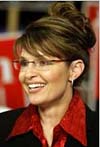
Sarah PalinExpectations had been that McCain would choose a more experienced politician. High on the list of potential VP candidates were Minnesota Gov. Tom Pawlenty, failed presidential candidate Mitt Romney, former Pennsylvania Gov. Tom Ridge and Sen. Joe Lieberman.
But picking a woman from outside the beltway could pay dividends with voters looking for confirmation that McCain is a maverick determined to change politics as usual. It also gives the McCain campaign the ability to claim that it, too, is potentially historic.
Palin went out of her way to invoke the precedents set by Geraldine Ferraro, the first woman on a Democratic presidential ticket, as well by Clinton, saying she had left “18 million cracks” in the highest glass ceiling in the land.
Then, making a direct appeal to Clinton’s supporters, she said, “It turns out that the women in America aren’t finished yet, and we can shatter that glass ceiling.”
The down side of the selection, however, is that by putting a first-term governor on the ticket, GOP attacks on Obama’s youth and inexperience may now ring hollow.
In addition, McCain and Palin have disagreed on energy policy, an issue that will play a major role in the general election. As governor of Alaska, Palin supports drilling in the Arctic National Wildlife Refuge. Earlier this week, The Weekly Standard described her as “the nation’s most prominent advocate” of drilling in the wildlife refuge that environmentalists see as one of America’s most precious natural wilderness areas.
McCain, who recently reversed his position on offshore drilling, had long opposed oil exploration in the wildlife refuge.
In her first remarks on a national stage, however, Palin stressed their shared belief in the need to challenge the status quo. “This is a moment when principle and political independence matter a lot more than the party line,” she said.
The daughter of a science teacher and school secretary, Palin is a former Miss Alaska runnerup, who holds a degree in journalism from the University of Idaho. She describes herself as “a hockey mom,” who initially got involved in politics through the PTA.
Palin served two terms on the city council of Wasilla, a suburb of Anchorage, AK, from 1992 to 1996, was elected mayor in 1996, and ran unsuccessfully for lieutenant governor in 2002.
After charging then-Republican Gov. Frank Murkowski with misconduct, she won election in 2006, by defeating the incumbent governor in the Republican primary, and then a former Democratic governor in the general election.
Details of Palin’s personal life have contributed to her own image as a political maverick. She hunts, eats moose hamburger, ice fishes, rides snowmobiles, and owns a float plane.
Her husband, Todd, is a commercial fisherman and, she noted in her introduction, “a proud member of the United Steelworkers union.” Outside the fishing season, he works for BP at an oil field on the North Slope and is a champion snowmobiler, winning the 2,000-mile Iron Dog race four times.
The couple have three daughters: Bristol, 17, Willow, 13, and Piper, 7. Three days after giving birth to her second son, Trig Paxson Van Palin, on April 18th, she returned to the office.
As governor, Palin is facing a state investigation related to her firing of Public Safety Commissioner Walter Monegan who alleged that his removal was due in part to his reluctance to fire an Alaska state trooper, Mike Wooten, who had been involved in a divorce and child custody battle with Palin’s sister, Molly McCann.
Palin disputes that charge, asserting Monegan was dismissed for not filling state trooper vacancies, and because he “did not turn out to be a team player on budgeting issues.”
In a prepared statement yesterday, the Obama campaign portrayed Palin as an ideologue without the experience to govern.
“Today, John McCain put the former mayor of a town of 9,000 with zero foreign policy experience a heartbeat away from the presidency,” said campaign spokesman Bill Burton. “Governor Palin shares John McCain’s commitment to overturning Roe v. Wade, the agenda of Big Oil and continuing George Bush’s failed economic policies – that’s not the change we need, it’s just more of the same.”
To hear McCain’s introduction of Palin, click here:
Click here to sign up for the Muckety Newsletter
Billionaire Charles Koch plays politics, but out of public eye (Muckety)
Charles G. Koch may be the richest and most politically connected mogul you’ve never heard of.
Koch (pronounced coke) heads Koch Industries, the world’s largest private company with oil refineries, gas pipelines, cattle ranches, paper mills and financial services that produce an estimated $90 billion in revenue a year. Although Koch is richer than George Soros or Carl Icahn – and spends millions each year to lobby Congress and to bankroll libertarian causes – he is largely unknown outside of his hometown of Wichita, KS.
Hint: Click in map to explore connectionsStory continues below interactive map
MAP HINTS: Click expands a name. Control+Click centers map on a name. Solid lines are current relations. Dotted lines are former relations. For advanced tools choose Tools > Options from the menu at top. More help. Not seeing the maps? Please go here to check for the latest version of Java.Which is apparently just the way he likes it.
“I don’t want to dedicate my life to getting publicity,” he told the New York Times more than a decade ago after his younger brother, William, a former America’s Cup winner, brought suit, claiming he had been cheated out of his rightful share of the company, and thereby, opening the company to scrutiny. The suit was eventually settled.
But though Charles Koch, now 72, prefers to fly below the radar, he is a true believer in what he refers to as the “science of market-based management.” Both he and his younger brother, David H., a co-owner of the family business, have disseminated Libertarian principles by pouring millions of dollars into conservative think tanks and advocacy groups, in addition to direct lobbying of Congress.
Koch Industries contributes more money to candidates through its political action committee (KochPAC) and its 80,000 employees, than any other oil or gas company – donating $1.15 million during the 2008 election cycle, according to the Center for Responsive Politics. The lion’s share of that, or 85 percent, went to Republicans; 15 percent went to Democrats.
(For comparison’s sake, the next biggest contributor, among major oil or gas companies, was Exxon Mobil, which donated $674, 359 in the 2008 cycle so far).
Very little, however, went to presumptive Republican nominee John McCain, though McCain has received millions from other oil and gas companies.
Although Koch Industry’s former top lobbyist – Nancy Mitchell Pfotenhauer – advises McCain on economic issues – the company has contributed only $6,750 to the GOP candidate thus far, according to the CRP. It has given nothing to Illinois Sen. Barack Obama, the presumptive Democratic nominee.
But Koch has donated generously to several Republican committees, including the Republican National Committee ($30,000), the National Republican Congressional Committee ($30,000), the National Republican Senatorial Committee ($30,000) and the National Democratic Senatorial Committee ($30,000), as well as to a slew of mostly GOP lawmakers.
Recipients of its largesse to Congress include Texas Republicans Joe Barton, Michael Burgess and John Culberson, and also Todd Tiahrt of Kansas (where Koch is headquartered), Paul Broun Jr. of Georgia, and Roy Blunt of Missouri; Top Senate recipients include Republicans Sam Brownback and Pat Roberts of Kansas, Mitch McConnell of Kentucky, Saxby Chambliss of Georgia, and John Barrasso of Wyoming, according to CRP.
But the brothers exert their greatest influence by seeding interconnected, libertarian-leaning advocacy groups and think tanks, bankrolled by foundations they control – the Charles G. Koch Charitable Foundation, the Claude R. Lambe Charitable Foundation and the David H. Koch Charitable Foundation, according to their tax filings.
Top recipients are the Cato Institute, the Reason Foundation, the Institute for Humane Studies, the Heritage Foundation, the Federalist Society and the Mercatus Center at George Mason University – all of which issue papers or advocate for the principles of free enterprise, market-friendly public policies including deregulation, and individual liberties.
David H. Koch was the Libertarian Party’s vice-presidential candidate in 1980, and serves as a director of the Cato Institute and the Reason Foundation, both Libertarian-leaning think tanks.
“It’s astounding that so few people have ever heard of a family this rich and powerful and aggressive when it comes to policy and politics,” analyst Jeff Krehely told the Center for Public Integrity. “When you talk about Koch, most folks think you are talking about the soft drink company.”
The Koches seem to have inherited their conservatism from their father. Fred Koch, the son of a Dutch immigrant who originally ran a Texas newspaper, developed a more efficient method of refining crude oil into gasoline in the late 1920s.
After being hit with patent suits from several oil companies, he emigrated to the Soviet Union where he helped build refineries for Josef Stalin. But he developed such a hatred for communism there that upon his return to the U.S., he became a member of the John Birch Society, according to a Forbes profile of the company.
All of his sons seem to have gotten his engineering gifts. Charles and David Koch got basic and advanced engineering degrees from the Massachusetts Institute of Technology. After working for several years for Arthur Little Inc., Charles Koch returned to Wichita after his father threatened to sell the business, and took control after his father’s death in 1967.
When he took over Koch Industries was a motley collection of oil pipeline assets with revenues of $250 million, according to the New York Times.
Charles expanded the pipelines and refineries, increased oil exploration and added natural gas, asphalt, paper products and chemicals to the product lines. Although there have been bumps along the way, he has grown the company into a conglomerate that sells everything from Stainmaster carpets and Dixie cups to oil and gas. His acquisition of Georgia-Pacific Corporation for $21 billion in late 2005 made Koch the largest privately held company in the nation.
Asked in 2006 whether he would ever sell shares of the company to the public, Charles Koch replied: “Over my dead body.”


0 Comments
There are no comments yet, be the first by filling in the form below.
Leave a Comment
<!–
XHTML: You can use these tags: <a href="" title=""> <abbr title=""> <acronym title=""> <b> <blockquote cite=""> <code> <em> <i> <strike> <strong>
–>