Category: Economy

  • Financial firms benefited from personal connections to Geithner

    Did financial firms with personal ties to then-Treasury Secretary Tim Geithner fare better in the economic meltdown than those who weren’t connected?

    Using Muckety maps and other data, researchers from MIT, the University of California at Berkeley and the University of Connecticut have determined yes, they did.
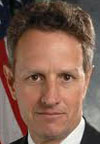
    Tim Geithner
    Tim Geithner

    Their study (pdf), initially released in May 2009 and updated in September of this year, found that companies with connections experienced abnormally high returns – as much as 11.2 percent – after President Obama’s announcement that he was nominating Geithner for the job.

    Geithner was already well connected in the financial community, having previously served as president and CEO of the Federal Reserve Bank of New York.

    The report suggests that the market “may have subscribed to a ’social connections meets the crisis’ hypothesis: that personal connections would matter during a time of crisis and increased policy discretion.”

    It was perhaps reasonable to suppose that immediate action with limited oversight would have to be taken, and that officials would rely on a small network of established confidantes for advice and assistance. Powerful government officials are no di¤erent from the rest of us; they know and trust a limited number of people. It is therefore natural to tap private sector
    people with relevant expertise when needed – including asking them for advice and hiring them into government positions. Even with the best intentions, beliefs are presumably shaped by self-interest, particularly when the people involved were, are, or will be executives with fiduciary responsibility to shareholders. These tendencies can be checked during ordinary times by institutional constraints and oversight, but during times of crisis and urgency, social connections are likely to have more impact on policy.

    The importance of personal networks is likely to decline as the crisis ebbs, researchers wrote.

    Geithner left Treasury in January and is now a fellow with the Council on Foreign Relations.

    Click here to sign up for the Muckety Newsletter


     Read related stories: Economy · Recent Stories  

    0 Comments

    • There are no comments yet, be the first by filling in the form below.

    Leave a Comment


    The relationship map to the left is interactive.
    • Solid lines are current relations. Dotted lines are former relations.
    • Expand items with + signs by double-clicking or by selecting multiple items in the map and pressing the “e” key.
    • Move an item in the map by clicking and dragging.
    • You can also delete items, separate boxes and save maps. Right-click on the map or select Map Tools for these options.
    • Find out more about an item in the map by right-clicking on the item and choosing Information about…
    • View map color key.
    • This interactive map requires Flash player.
    • Republicans among Heritage Foundation’s most vocal critics

      October 22, 2013 at 9:05am

      “Is Heritage going to go so political that it really doesn’t amount to anything anymore?”

    • We are all Keynesians now – but especially Paul Krugman

      Economist John Maynard Keynes, often described as the man who saved capitalism during the Great Depression, may have been the right man at the right time.

      Economist Paul Krugman, who describes Keynes as his “economic idol,” may also be the right man at the right time. But supporters of Barack Obama certainly hope not.

      Hint: Doubleclick on boxes with plus signs to expand, or click the tool bar at left for more options.

      MucketyMap

      MAP HINTS: Boxes with + signs can be expanded by doubleclicking. Solid lines are current relations. Dotted lines are former relations. For more options, right-click on a box or click on the map tools to the left. (Requires Flash)

      Krugman – Nobel laureate, Princeton professor and New York Times columnist, is following in his hero’s footsteps by becoming the most prominent critic of government recovery strategies during a severe economic crisis.

      Paul Krugman
      Paul Krugman

      Democrats who reveled in Krugman’s constant criticism of the Bush White House are now squirming under his attack on Obama’s economic policies. While Krugman agrees with Obama’s injecting massive amounts of capital into the system to help jumpstart the economy, he believes the administration is being timid and spending too little.

      The biggest fear among Obama backers is that history could be repeating itself. Here’s a passage from Liaquat Ahamed’s new book, Lords of Finance:

      “During every act of the drama so painfully being played out, he refused to keep quiet, insisting on at least one monologue even if it was from offstage. … He was not a decision maker. In those years, he was simply an independent observer, a commentator. But at every twist and turn of the plot, there he was holding forth from the wings, with his irreverent and playful wit, his luminous and constantly questioning intellect, and above his remarkable ability to be right.”

      Ahamed is describing Keynes’ role during the 1930s. Krugman has taken on similar prominence in the current crisis.

      This week’s edition of Newsweek features him on its cover, with the headline, “Obama is wrong.”

      The magazine describes Krugman as the president’s “loyal opposition,” cementing his rank as Obama’s most influential naysayer. Yet administration officials recognize that Krugman is too big to criticize.

      “The Obama White House is careful not to provoke the wrath of Krugman any more than necessary,” writes Newsweek’s Evan Thomas. “Treasury officials go out of their way to praise him by name (while also decrying the bank-rescue prescriptions of him and his ilk as “deeply impractical”).”

      White House bulldog Rahm Emanuel did take a sidelong swipe last month, saying that critics such as Krugman had never dealt with the legislative process. “How many bills has he passed?” Emanuel asked.

      Yet Krugman has been disturbingly prescient. His book, The Return of Depression Economics, which focused primarily on the crisis in Asia, was published in 2000. It has been reissued, with updates pointing up the similarities to the current crisis.

      “I believe not only that we’re living in a new era of depression economics,” he writes, “but also that John Maynard Keynes – the economist who made sense of the Great Depression – is now more relevant than ever.”

      Click here to sign up for the Muckety Newsletter


      Follow Muckety on Twitter


      Muckety's Facebook page


       Read related stories: Economy  

      2 Comments

      • #1.   Donald Sutherton 04.03.2009

        The United States of America does not have the great democracy it thinks it has. What the US actually has is a plutocracy, which is corrupt and circumvents the very values it purports to believe in.
        Although I agreed with the premise of your article, it is yet another example of how party politics and jingoism in the US consumes the corporate media, and the vast majority of the population. When the right questions are asked, the commercial media and the two largest political parties ensure these questions never become part of the public discourse. Just consider how the public debates of candidates are co-opted in the US by the Republican and Democratic parties and the absolute complicity of the media. What a sham! Even Michael Moore shares in this blame when he publically begged an independent to withdraw from the presidential race while never acknowledging that not only was that independent blocked by both parties from participating in the debates, he was threatened with being charged with trespassing when he tried to attend the debates as a US citizen. Americans are so mired in this process and group think that as a nation few ask the right questions. George W. Bush is a war criminal and one of the worst in US history, but so are several other past presidents war criminals; both Republican and Democrat. As for the Obama administration, the world is hoping ( me included) the US will start living up to the values it claims to believe in. However, Obama has many of the wrong people in his cabinet. This is not a good sign for the future.
        Here are a couple of questions that should be on everyone’s mind.
        Why was the Bush administration’s approval ratings so high, and why was that administration elected to a second term? Yeah, we all know he lied, but why are so many so gullible when the rest of the world saw right through the propaganda?
        Why has Obama appointed so many to his administration that have directly contributed to this historical global socioeconomic crisis?

      • #2.   Laurie Bennett 04.04.2009

        What makes you think we’re part of “the corporate media”?

      Leave a Comment